
Criminal Cases in the Pennsylvania Courts
Pennsylvania criminal cases can pass through more than one court. Magisterial District Courts handle preliminary arraignment, bail, preliminary hearings, and most summary matters outside Philadelphia. Philadelphia Municipal Court fills much of that lower-court role within Philadelphia, while Pittsburgh Municipal Court handles specified arraignment, bail, and preliminary work. A felony or misdemeanor held for court then moves to the county Court of Common Pleas for formal charges, a plea or trial, and sentencing. Most criminal appeals go to Pennsylvania Superior Court. The Pennsylvania Supreme Court is the highest state court and hears direct categories plus cases accepted for further review.
The Pennsylvania judiciary's court-structure overview shows how the trial and appellate levels fit together.
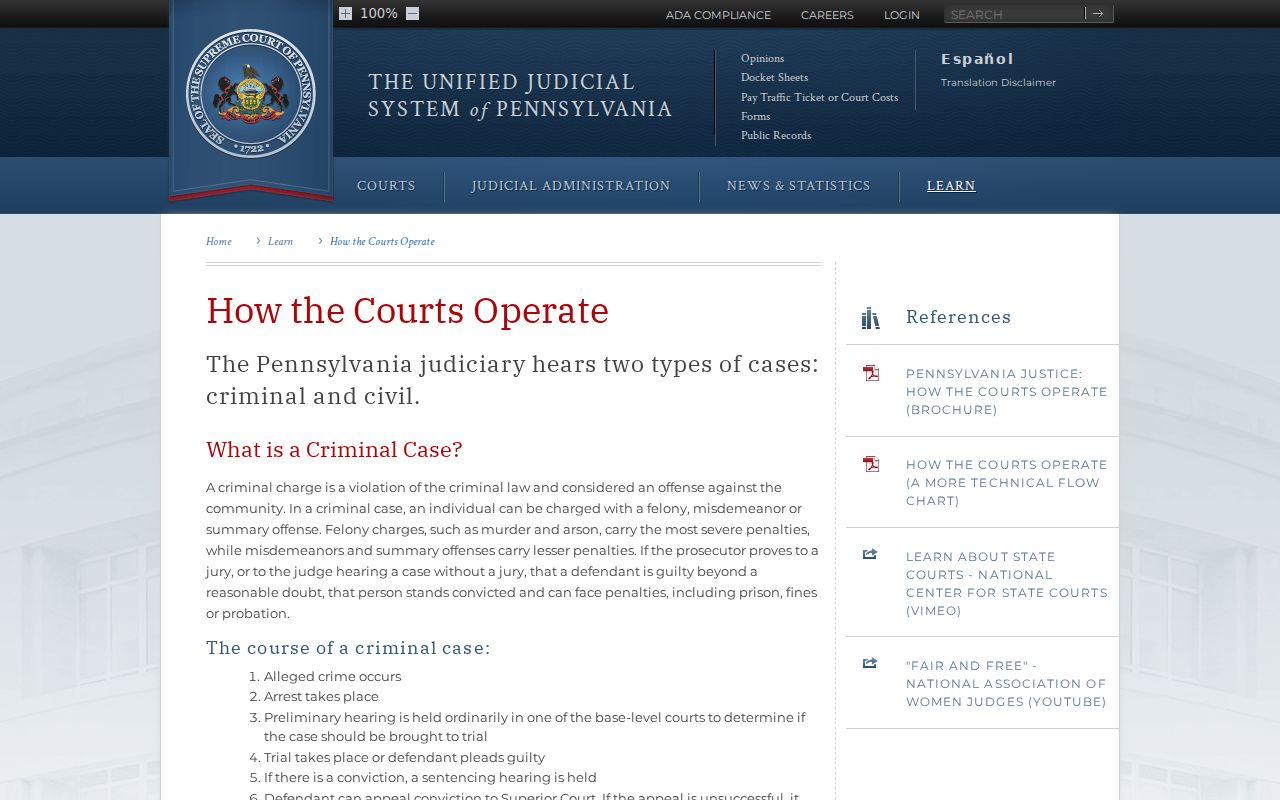
That hierarchy matters because an early lower-court docket and the later Common Pleas docket can describe different stages of the same Pennsylvania prosecution.
Search Both Pennsylvania Court Levels
A single participant-name search can give an incomplete view. The lower-court docket records the complaint, preliminary arraignment, bail, and preliminary hearing. When charges are held for court, the Common Pleas docket becomes the main record of the information, formal arraignment, pretrial activity, plea or trial, outcome, and sentence. Search Magisterial District Court or Philadelphia Municipal Court records first when the event is recent. Then search Common Pleas criminal, Summary Appeal, and Miscellaneous docket types when the facts call for them.
Pennsylvania has 60 judicial districts serving 67 counties, and some districts pair counties. The public docket system joins those court levels in one access point, but it does not merge every stage into one file. Compare the Offense Tracking Number, incident number, city, and available birth data. Never rely on a name alone. A scheduled event may also be continued or canceled, so read the event status and later entries before treating the calendar as final.
How to Search Pennsylvania UJS
The free UJS Public Web Docket Sheets cover Pennsylvania appellate cases, Common Pleas criminal cases, Magisterial District Court matters, and Philadelphia Municipal Court cases. No login is required. Start with the most exact key available. A docket number is best. The OTN or police incident number can connect related stages. For a name search, UJS advises using fewer fields at first because an optional date of birth can suppress a valid match when the older entry lacks that data.
- Choose the court type and the criminal, summary-appeal, miscellaneous, traffic, or nontraffic docket type that fits the event.
- Search by docket number, OTN, or incident number when known. Otherwise enter the last name and minimal extra detail.
- Select a county or use statewide coverage where the chosen mode permits it. Review close matches against several identifiers.
- Open each likely docket and read every charge, bail action, scheduled event, disposition, sentence, and financial entry.
- Ask the filing court for pleadings, orders, older material, or certified copies that the docket only lists.
| Field Label | Type | Required | Notes |
|---|---|---|---|
| Search By | Dropdown | Yes | Name, docket, organization, OTN, incident, SID, or calendar mode |
| Court Type | Dropdown | Yes | Appellate, Common Pleas, MDJ, or Philadelphia Municipal |
| Docket Type | Dropdown | Conditional | Includes criminal, summary appeal, miscellaneous, traffic, and nontraffic |
| County | Dropdown | No | All 67 Pennsylvania counties are listed |
| Last and First Name | Text | Last name in participant mode | Use less data first; compare results carefully |
| Date of Birth | Date | No | Can hide a valid match when a source record lacks birth data |
| Docket Number | Structured input | In docket mode | Fastest route to one known Pennsylvania case |
| OTN or Incident Number | Text | In identifier mode | Useful for linking an arrest and related court records |
The official UJS search help documents these modes and the portal's troubleshooting advice.
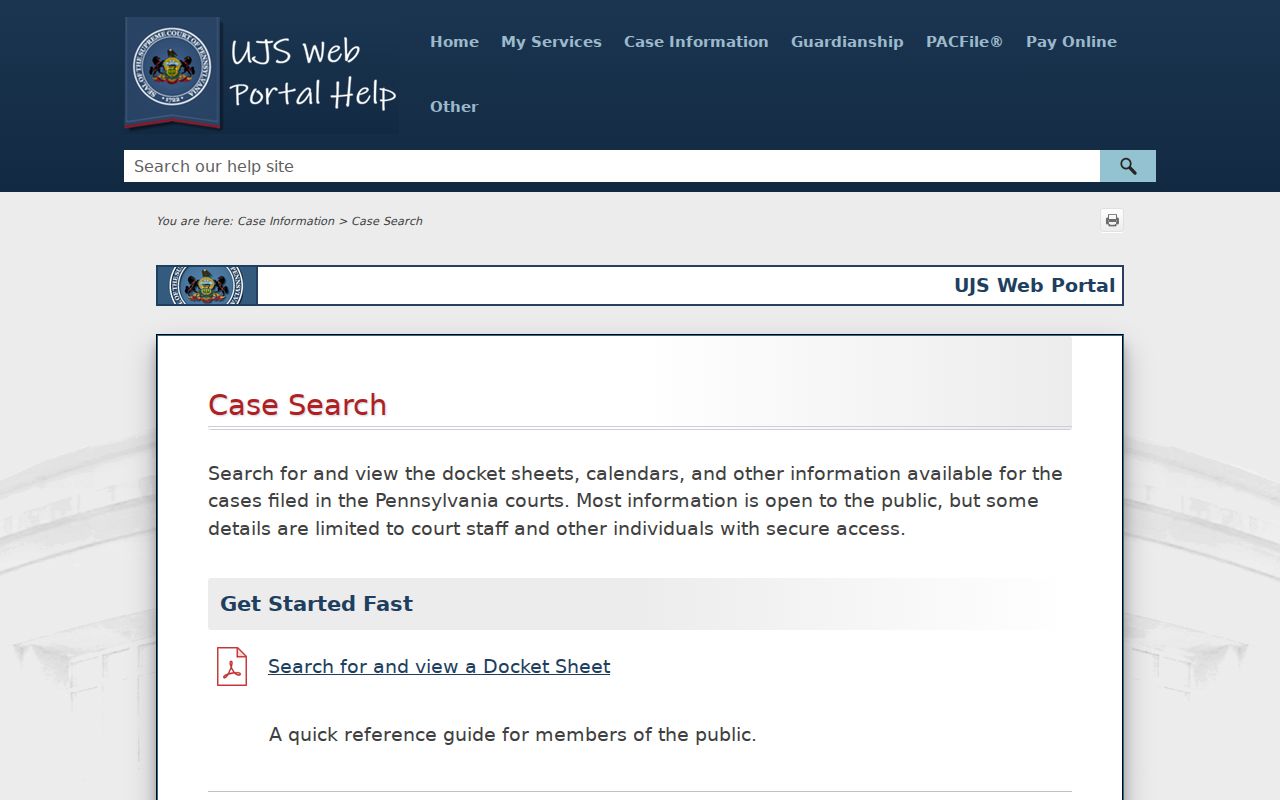
The field layout supports both broad discovery and exact identifier searches, which is why a second search method can resolve a missed name result.
OTN Links Pennsylvania Criminal Cases
The Offense Tracking Number, or OTN, follows an arrest and charge cycle across police, lower courts, Common Pleas, and repository reporting. It is often the best way to test whether two Pennsylvania docket sheets describe the same criminal matter. A lower docket may use a format beginning with “MJ,” while a Common Pleas criminal number begins with “CP” and includes a county code, criminal designation, sequence, and year. Different docket numbers do not mean different incidents when the OTN matches.
A State Identification Number is different. The SID is fingerprint-supported and helps Pennsylvania agencies connect identity records. UJS permits an SID search mode in some contexts, but public electronic policy excludes the SID itself from display. The OTN is therefore the more visible bridge for a reader. An incident or complaint number can supply another check. Use several facts together because names, aliases, and data-entry differences can still create false matches.
- OTN
- Offense Tracking Number linking one arrest and charge cycle across Pennsylvania systems.
- Docket number
- The court's own identifier for a case at a particular level.
- Disposition
- The outcome of each charge, such as dismissal, nolle prosequi, plea, acquittal, or conviction.
- Nolle prosequi
- A prosecutor's formal choice not to continue a charge; it is not a conviction.
What the Case File Shows
A Pennsylvania docket is a detailed index, not the full documentary file. It can show the caption, court, judge, dates, related dockets, lower-court origin, arresting agency, bail history, charge sequence, statute, grade, events, outcomes, sentence, and financial obligations. It may list a complaint, information, motion, order, or plea document without offering the PDF. The county Clerk of Courts remains the custodian for the Common Pleas filing set.
| Case Number & Court | Identifies the docket level, county code, sequence, year, and assigned court. |
|---|---|
| Charging Documents | Lists the complaint and later information, but the actual documents may require a court request. |
| Docket Entries | Chronology of filings, hearings, judicial actions, and processing statuses. |
| Bail & Events | Actions, types, amounts, posting details, and scheduled or completed appearances. |
| Disposition | Charge-by-charge outcome and date; inspect each count separately. |
| Sentence & Judgment | Penalty, confinement or supervision terms, costs, restitution, and payment entries where reported. |
Note: A processing status such as “Awaiting Trial” is not a final disposition, and each Pennsylvania charge can end differently.
UJS Is Not a PATCH Check
UJS and PATCH answer different questions. A UJS docket is the procedural record of one Pennsylvania court case. It shows what was filed, what happened in court, and how individual counts ended. PATCH is a Pennsylvania State Police repository product based on identifiers submitted for a statewide criminal-history check. A PATCH result is not the county's pleading set, and a UJS search is not an identity-linked statewide rap sheet.
Timing can also split the records. A county docket may show a new outcome before the court's disposition reaches the PSP Central Repository. Pennsylvania law directs covered sources to send specified disposition information within 90 days, but missing fingerprints, name differences, unmatched identifiers, or source errors can delay the match. Use the docket to understand the case. Use the repository for its designated statewide history product. Then verify disputed data with the office that created it.
Stages of a Pennsylvania Criminal Case
A Pennsylvania criminal matter usually begins with an investigation, arrest or summons, complaint, preliminary arraignment, and bail decision. A preliminary hearing tests whether a felony or misdemeanor should proceed. If held for court, the prosecution files an information in Common Pleas. Formal arraignment and pretrial work follow. Some cases enter Accelerated Rehabilitative Disposition, a pretrial diversion program that can lead to dismissal and expungement after successful completion. Others end through a plea, trial, dismissal, acquittal, or nolle prosequi.
Case flow: Charges Filed › Arraignment › Pretrial › Plea or Trial › Disposition › Sentencing
Read later entries before relying on an early charge. Counts can be amended or withdrawn, hearings can move, and the sentence follows only after a conviction or accepted plea. Pennsylvania uses prompt or without-unnecessary-delay language for preliminary arraignment. It does not impose the universal 24-hour or 48-hour appearance rule sometimes repeated online. The verified 48-hour rule concerns forwarding qualifying fingerprints to PSP.
The official Pennsylvania court process resource supplies the statewide context and helps place each docket event at the right point in the case path.
Pennsylvania Criminal Court Redactions
Public electronic access has defined limits. Pennsylvania court policy withholds Social Security numbers, driver's license numbers, street addresses, financial credentials, victim and witness identifying data, sealed material, and unexecuted warrant information. Juvenile, expunged, pending-expungement, and limited-access or Clean Slate cases are not ordinary public search results. Records destroyed under retention rules also cannot appear. A blank search is therefore not proof that no case ever existed.
The Pennsylvania judiciary's public-record policies identify the rules that govern court records.
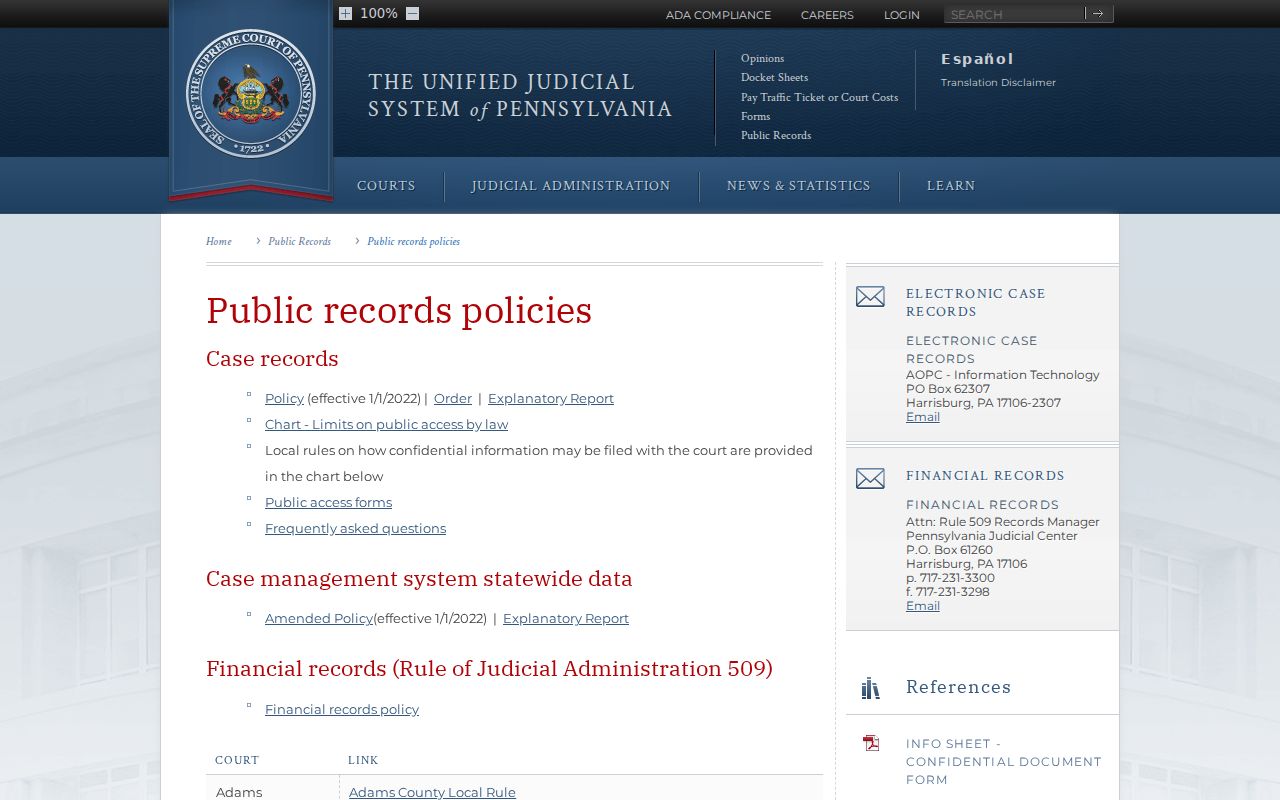
Those policies explain why the public docket omits protected fields even when the filing court retains an official record.
Finding Case Records by County
The complete criminal case file sits with the county Clerk of Courts for the Court of Common Pleas where the case was filed. Start with UJS to identify the docket. Then ask the clerk for the complaint, information, motions, orders, plea papers, sentence documents, or certified copies. For a preliminary matter, the Magisterial District Court or municipal court may hold the source file. Local fees and archive methods can differ, and problem-solving courts such as drug, veterans, or mental-health courts vary by judicial district.
The statewide court record request and correction forms provide the standard route for access or a claimed web-docket error.
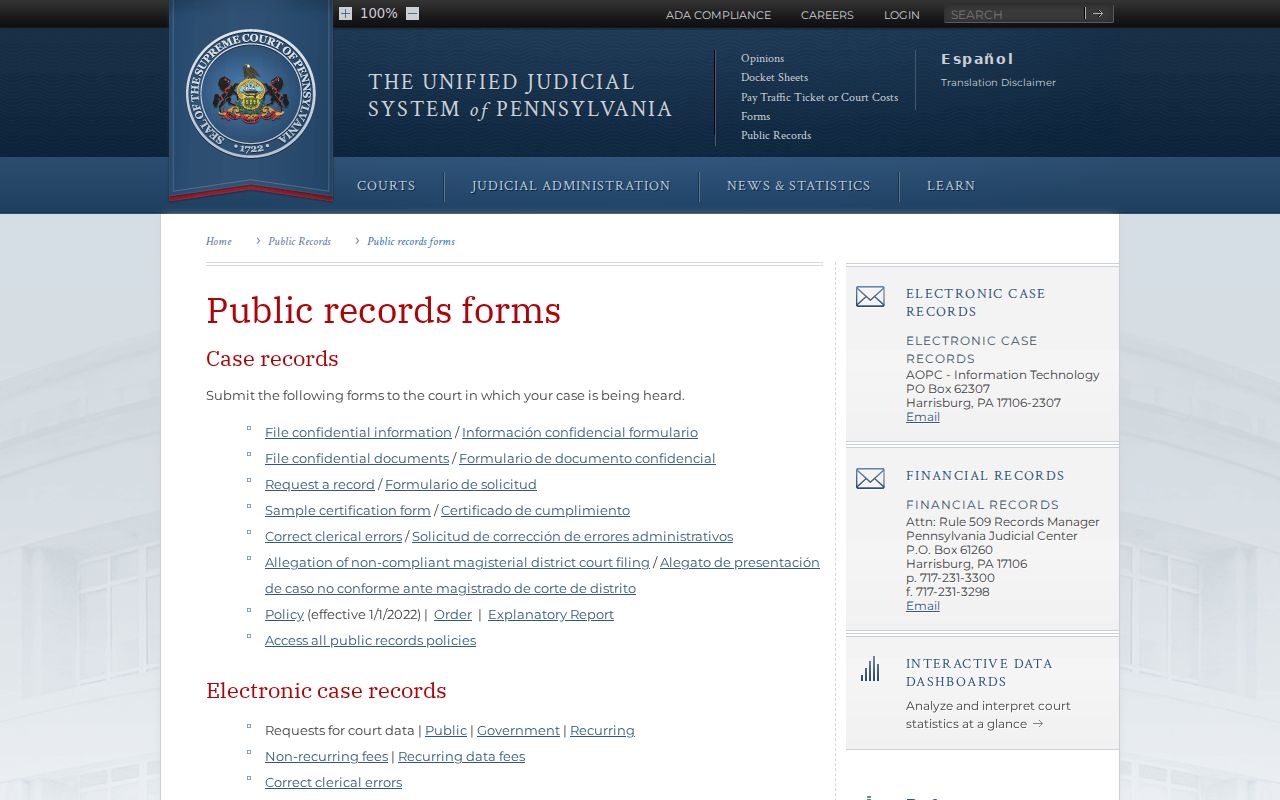
A properly directed request can produce the document itself when the UJS docket shows only the filing title.
Written electronic-record requests receive a fulfillment, fee notice, defect notice, denial, or expected response date within ten business days under UJS policy. Browse the directory of all 67 Pennsylvania counties to reach the criminal-record resource for the county that created the case file.
Read Pennsylvania Dockets Carefully
The live Pennsylvania UJS case-information portal is the statewide starting point for public docket review.
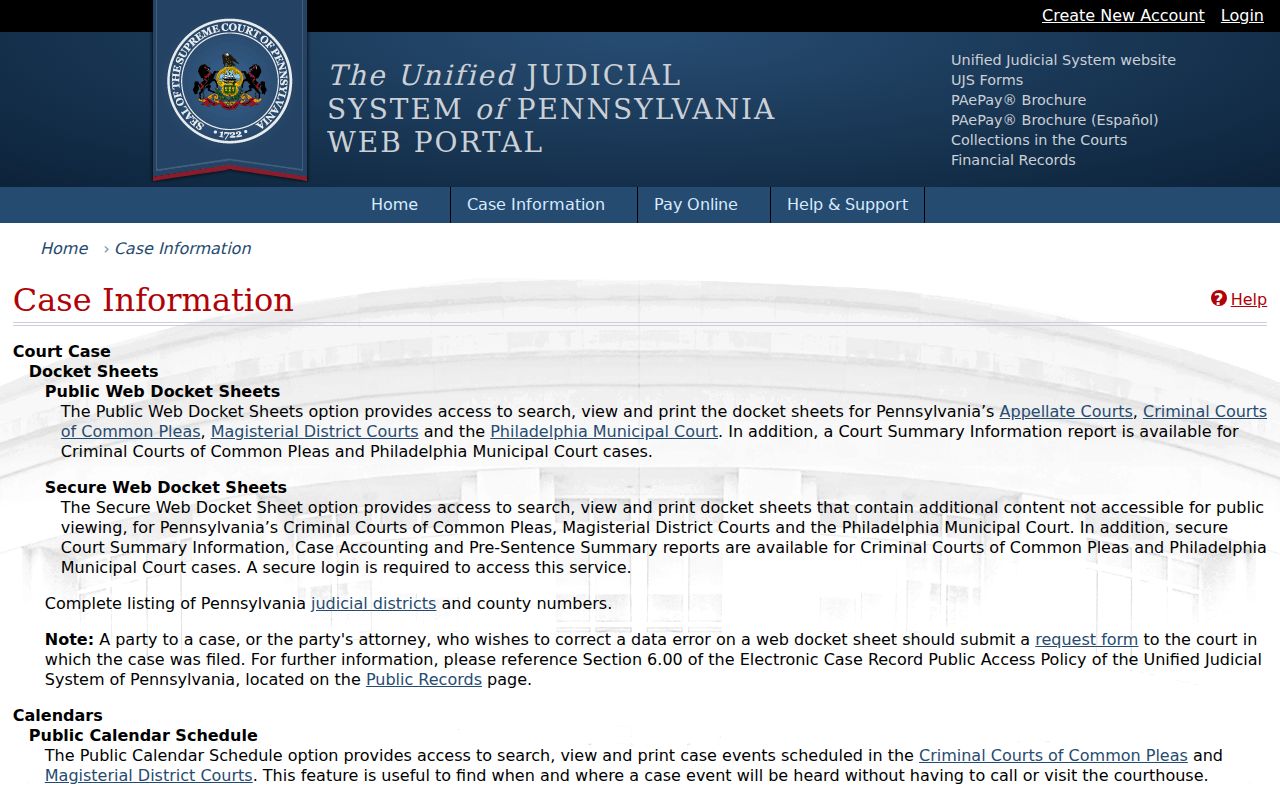
The portal gives broad access, but the filing court remains the authority for certified records, corrections, and any document not posted electronically.
Use the printed date and accuracy notice on each docket. Check the latest events, not just the caption or initial charges. Bail is separate from guilt. A “Completed” or “Closed” status should still be read beside the count-level dispositions. Financial entries may not reflect a same-day payment, and a calendar listing is not proof that an event occurred. These checks keep a Pennsylvania criminal court search tied to what the record actually says.