
About the Pennsylvania State Police
The Pennsylvania State Police is the agency named by Pennsylvania's Criminal History Record Information Act to operate the Central Repository. Section 9102 describes the repository as the central location for collecting, compiling, maintaining, and disseminating criminal-history record information. The current public-facing unit is the Criminal Records and Identification Division. Older PATCH language may call the broader records unit the Bureau of Records and Identification, but both references point readers back to PSP's repository work.
PSP links arrest cycles, fingerprints, charges, court outcomes, sentences, correctional events, probation or parole information, and pardons when source agencies report them. It also administers the Multi-Biometric Identification System, Pennsylvania Access To Criminal History, the restricted CLEAN network, Pennsylvania's crime-reporting system, and the Megan's Law registry. PSP is the identity-linkage and dissemination center, not the creator of every field in a rap sheet.
PSP PATCH and Full Own-Record Review Are Different
PATCH is the ordinary name-based Pennsylvania certificate product. It compares submitted identifiers with disseminable Central Repository information and returns a status of No Record, Record, or Under Review. A No Record certificate means the entered identifiers did not produce information releasable through that product. It does not rule out a county docket, an out-of-state or federal event, a limited record, or an entry indexed differently.
SP 4-170 Access and Review is reserved for the record subject or legal representative. It returns the subject's entire Pennsylvania history, including convictions and nonconvictions, for review and challenge. It costs $20, requires photo identification, travels by mail, and warns that processing can take three months or longer. That scope and timing must not be confused with ordinary PATCH.
SP 4-164 is the mailed counterpart to the ordinary result. The standard version costs $22, while the notarized mail option costs $27. Mail payments use a certified check or money order payable to the Commonwealth of Pennsylvania, not cash or a personal check. A qualifying unpaid volunteer uses SP 4-164A at no charge, but that result cannot be notarized. Keeping these form numbers separate prevents a fast public certificate from being mistaken for the slower statutory review needed to inspect and challenge one's own full Pennsylvania file.
Criminal History Checks Offered by Pennsylvania State Police
PSP separates products by the requester's authority and the requested record scope. The ordinary online and mail routes return Pennsylvania repository dissemination, the volunteer form applies only to a qualifying unpaid role, and Access and Review invokes the subject's statutory right to see a broader file. IdentoGO and FBI eDO are distinct fingerprint channels rather than upgraded versions of PATCH.
The official Pennsylvania State Police product guide presents the current public forms, charges, payment rules, and processing notes.
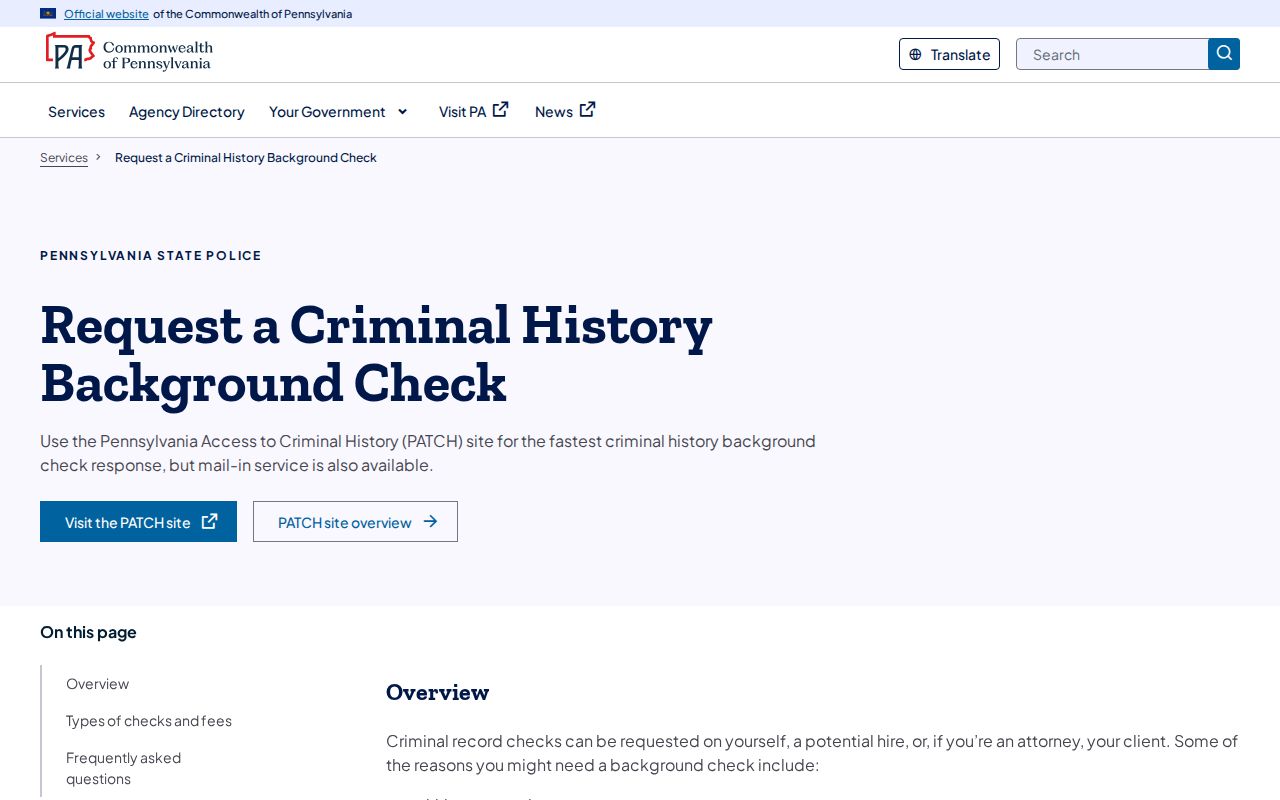
The source confirms why the product name matters: each channel has a different return, fee, and eligibility rule.
| Product | Who May Order | What It Returns | Cost |
|---|---|---|---|
| PATCH online / SP 4-164 | Any requester | Name-based Pennsylvania Central Repository result | $22 |
| Notarized SP 4-164 | Requester needing notarization | Notarized Pennsylvania repository result by mail | $27 |
| SP 4-164A | Qualifying unpaid volunteer | Pennsylvania repository result; not notarizable | Free |
| SP 4-170 Access and Review | Record subject or representative | Entire Pennsylvania history for review and challenge | $20 |
| FBI Identity History Summary | Record subject | Fingerprint-based federal identity history | $18 plus capture |
| IdentoGO program check | Person directed by an authorized program | Program-specific FBI result using its service code | Varies |
How Pennsylvania State Police PATCH Status Works
Both registered and unregistered users can submit up to ten subjects per session, with a separate charge for each ordinary request. Nonregistered users re-enter contact and payment information because PSP does not retain it across sessions. Accurate legal and alias names, date of birth, and any accurate optional identifiers reduce name-match ambiguity. The requester should preserve the control number and request date.
The official PSP PATCH portal provides request entry, status retrieval, and certificate validation in one public system.
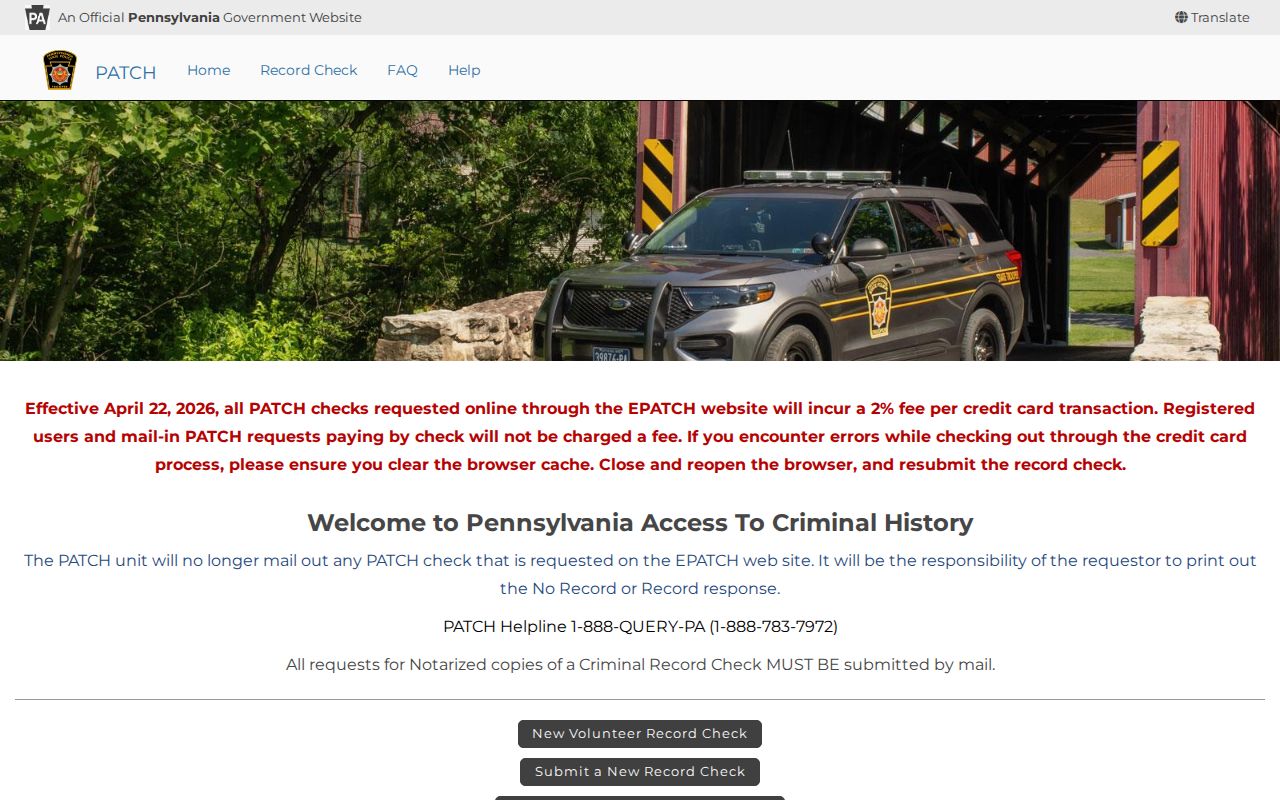
A status of Under Review is neutral and can resolve to Record or No Record. PSP says many No Record certificates are immediate, while manual review may take two to four weeks. Validation requires the control number, subject name exactly as entered, and request date.
How Records Flow Into the Pennsylvania State Police Repository
A municipal department, PSP troop, sheriff, campus department, or another authorized agency creates the arrest record. More than 200 Pennsylvania digital booking sites capture identifying data, Livescan fingerprints, palmprints, and CPIN photographs. Under 18 Pa.C.S. § 9112, qualifying felony and misdemeanor arrest fingerprints must reach the Pennsylvania State Police Central Repository within 48 hours.
Data flow: County Arrest › Fingerprint Submission › Pennsylvania State Police Central Repository › Court Disposition Reporting › Rap Sheet
Courts report charge outcomes, while corrections and supervision bodies report the fields assigned to them. Section 9113 generally gives specified sources 90 days to transmit dispositions. The OTN, SID, fingerprints, and docket number connect stages. A county docket can therefore show a new result before PSP does. Missing prints, unmatched identifiers, reporting lag, and source errors can also cause disagreement, so the freshest supporting document often remains with the county that created the record.
Inside Pennsylvania State Police MBIS
PSP replaced its NEC Automated Fingerprint Identification System with IDEMIA's Multi-Biometric Identification System in June 2022. MBIS holds demographics, fingerprints, palmprints, and photographs, and exchanges data with the FBI's Next Generation Identification environment. That biometric layer is why fingerprint-linked identity is stronger than a name-only comparison.
PSP reported 1,103,622 MBIS fingerprint submissions in 2024, of which 791,516, or 71.72 percent, were noncriminal-justice submissions. Those figures count submissions, not unique people. Earlier federal support helped fund the transition, while later work included sending corrected older cases to FBI NGI and reprocessing older latent prints.
How to Order a Pennsylvania State Police Check
Start with the question the official product must answer. PATCH and SP 4-164 provide ordinary Pennsylvania repository dissemination. SP 4-170 is the own-record route. A notarized result is mail-only. A program-directed FBI fingerprint request begins with the directing program's service code, while a personal federal Identity History Summary begins with FBI eDO.
- Choose PATCH, SP 4-164, SP 4-164A, SP 4-170, IdentoGO, or FBI eDO according to scope and eligibility.
- Gather accurate identity details, the correct form and photo ID, or fresh fingerprints and an authorized service code as required.
- Submit online, mail the signed form, or preregister with the official fingerprint channel. Do not guess a service code.
- Pay the product's stated charge and retain the control number, mailing proof, or fingerprint transaction receipt.
- Read the result within its limits, then obtain the UJS docket and certified county outcome for any entry needing case detail.
PSP, IdentoGO, and FBI Fingerprint Channels
IdentoGO is a program-directed capture vendor, not a public fingerprint upgrade to PATCH. A person sent there must preregister with the exact service code from the authorizing Commonwealth program, use the current location finder, and bring accepted identification. Fees vary by program, so Pennsylvania does not publish one universal fingerprint price.
The official IdentoGO enrollment portal handles Pennsylvania preregistration, service-code entry, and live location selection.
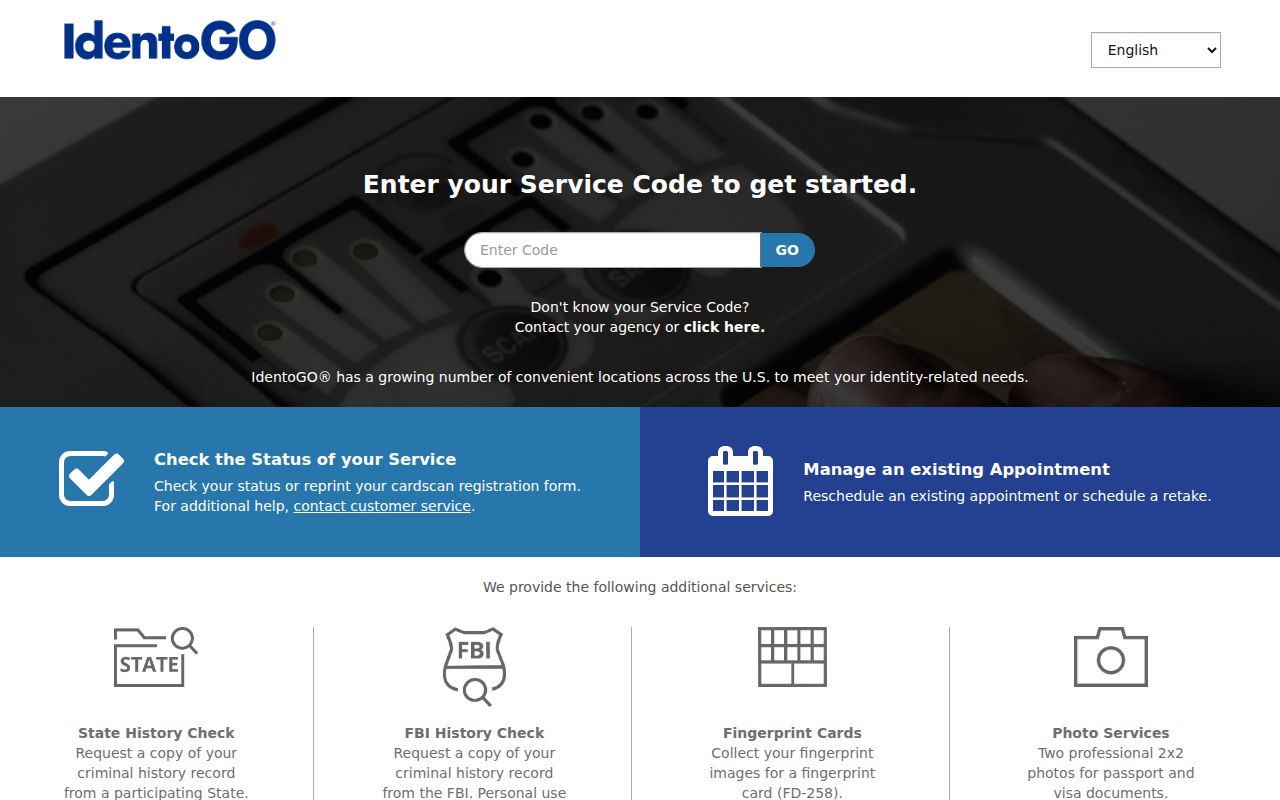
The displayed workflow helps keep a program-routed result separate from a personal federal report, which may not be delivered to the same recipient.
A person seeking their own federal history instead uses the FBI electronic Identity History Summary service and submits current fingerprints through eDO, a participating Post Office, mail, or an approved channeler.
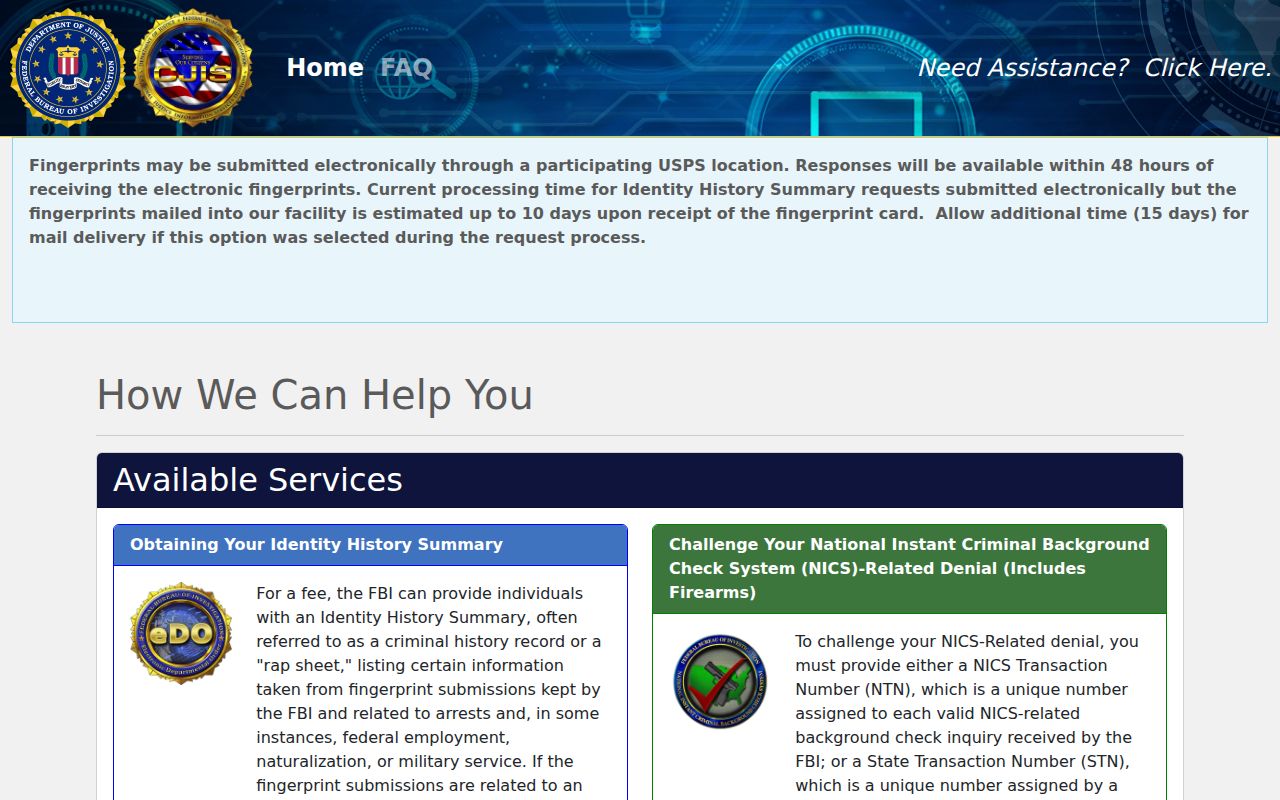
The FBI charge is $18 plus any capture or channeler cost. The summary is subject-only, is not expedited, and may show the submitting agency, arrest date, charge, and disposition when those details were supplied.
Pennsylvania State Police Checks vs County Records
A PSP check compiles reportable events across Pennsylvania. A county file preserves the original docket, pleadings, certified disposition, and current procedural history for one case. Neither replaces the other. PATCH is not a court-document archive, and a county search is not a statewide identity-linked rap sheet. Use the Pennsylvania county directory to reach the source jurisdiction when a repository line needs proof or context.
| PSP Check | County Records | |
|---|---|---|
| Coverage | Repository reporting from all 67 counties | Arrests, custody, and cases in one source county |
| Source | Fingerprint-linked compiled criminal history | Original court, booking, and agency files |
| Freshness | Depends on source transmission and matching | Changes as the local case or custody event moves |
| Detail | Summary arrest cycles and dispositions | Docket events, pleadings, orders, and certified outcomes |
| Best for | Statewide Pennsylvania history or own-record review | Verifying the exact event and obtaining documents |
What PSP CLEAN Can See That the Public Cannot
The Commonwealth Law Enforcement Assistance Network is a restricted justice network. It connects Pennsylvania criminal-history information with protection orders, wanted and stolen property files, JNET, FBI NCIC, and Nlets. Public users cannot sign into CLEAN or JNET to get a more complete warrant or criminal-history view. PATCH deliberately sits outside that protected environment.
The official Pennsylvania State Police CLEAN overview describes the participating systems and restricted operational scale.
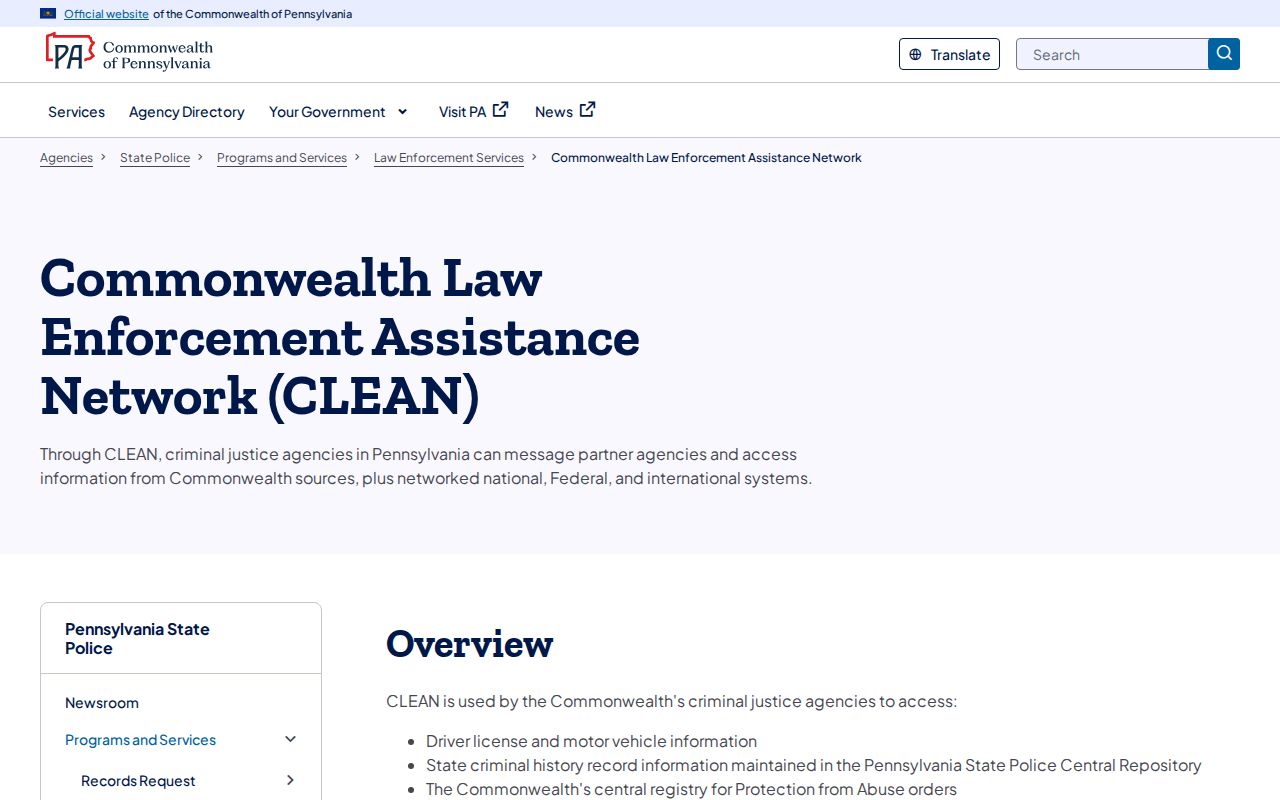
PSP reports roughly 1.9 to 2.1 million CLEAN transactions per day with an average 2.5-second turnaround, figures that describe system traffic rather than public record volume.
Correcting Errors in Your Pennsylvania State Police Record
Sections 9151 through 9153 give a record subject review, challenge, and appeal rights. Begin with SP 4-170 rather than an ordinary PATCH certificate, then compare each disputed arrest and outcome with UJS and the certified county result. A challenge should identify the exact segment and the correct facts. Under § 9152, the agency has 60 days and bears the burden of proving accuracy.
- Mail SP 4-170 with government photo ID, the $20 certified check or money order, and representative papers if applicable.
- Match every arrest cycle to UJS and obtain the certified outcome from the county court that entered it.
- Challenge the specific PSP segment with the correct information and supporting source documents, preserving proof of submission.
- Confirm the corrected certified copy; appeal a denial to the Attorney General within 30 days, then to Commonwealth Court if needed.
A valid challenge requires correction, a certified corrected copy, replacement or destruction of erroneous criminal-justice copies, and notice concerning noncriminal-justice recipients of the bad data. If the error exists in UJS rather than PSP, send AOPC's correction form to the filing Clerk of Courts or Magisterial District Judge first. Source-first correction helps the update propagate through the federated system.
A record that is accurate but legally eligible for expungement or limited access follows a different route. The filing occurs in the Court of Common Pleas with jurisdiction over the arrest or conviction. After an order, the county court transmits it to PSP for repository processing. Automatic Clean Slate cases also depend on exchanges among AOPC, PSP, and the courts. Check the result afterward with a fresh SP 4-170 and a UJS public search rather than assuming that one office's update immediately changed every connected layer.
From AFIS to Pennsylvania State Police MBIS
The institutional timeline explains why Pennsylvania records live in connected but separate layers. PSP was created in 1905. Pennsylvania's state and highway patrols merged in 1937 under the Pennsylvania Motor Police name, then became Pennsylvania State Police in 1943. Identification work progressed from ink fingerprint cards to computerized AFIS, digital Livescan and CPIN booking, and the 2022 MBIS transition.
PATCH was operating by fiscal year 2003 through 2004, while statewide UJS online docket access began with appellate dockets in 2001. Those public milestones did not merge the two systems. PSP continued to compile and disseminate identity-linked history, and AOPC continued to publish procedural court data. The durable method is still to use PSP for the compiled Pennsylvania history and the county court for the documentary file.