
Running a Check in Pennsylvania
The Pennsylvania State Police Megan's Law Public Website is the Commonwealth's official public-notification registry. It covers active registrants who live or are transient in Pennsylvania, and people with qualifying Pennsylvania work or school ties. All active categories are searchable without a fee. A user accepts the site's terms and completes reCAPTCHA before seeing results; only alert subscriptions require a Keystone Login.
The list is current rather than historical. A person may leave the public site after completing a registration period, moving away without a continuing Pennsylvania work or school connection, or dying. Absence is not proof that an old conviction never existed. For the court record behind a registration entry, use the Unified Judicial System docket and the filing county. The Pennsylvania county directory routes local registration questions to the appropriate area.
Nine Ways to Search Pennsylvania's Registry
Pennsylvania offers separate name, county, municipality, city, ZIP, mile-radius, non-compliant, SVP/SVDC, and transient searches. These are not interchangeable filters on one screen. County results can reflect residence, work, school, incarceration, or another statutory tie, so a result should not automatically be described as a county resident. Municipality search is useful when a legal township or borough differs from the USPS city name.
The official Pennsylvania Megan's Law name-search page shows the first-name, last-name, Soundex, and incarcerated-person options in context.
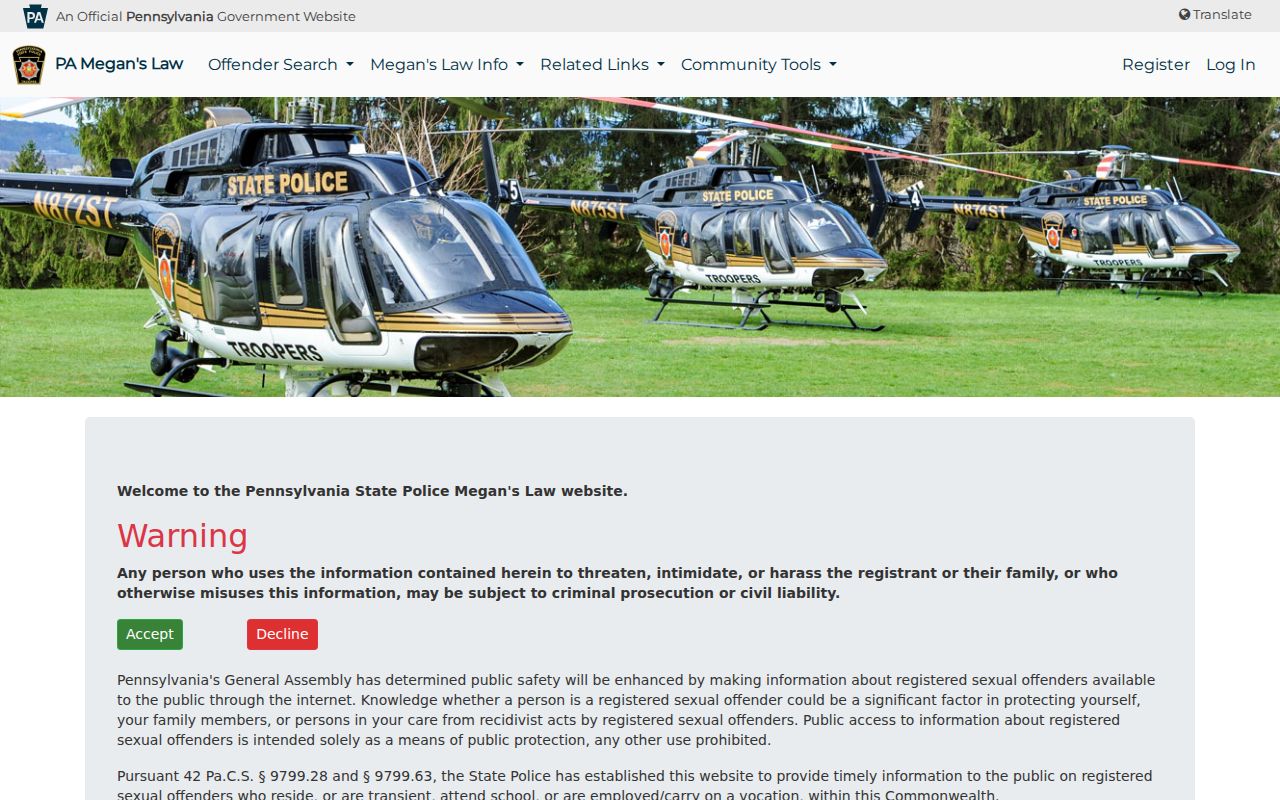
The screen reinforces why aliases and optional Soundex can broaden a search, though every extra match still needs careful profile comparison.
Searching the Pennsylvania State Police Megan's Law Website
Choose the search that matches what is actually known. Name search requires at least a first or last name and checks reported aliases. A geographic sweep works best when repeated by ZIP, municipality, and county because postal and municipal boundaries differ. Open the profile only after comparing its listed locations and identifying details; PSP states that only fingerprints establish positive identity.
- Open the PSP Megan's Law Public Website, accept its terms, and choose one of the nine public search modes.
- Enter a name, legal municipality, USPS city, five-digit ZIP, county, or validated Pennsylvania address as the selected form requires.
- Review likely profiles by photograph, aliases, year of birth, physical descriptors, locations, vehicles, offense, and update date.
- Create a Keystone Login only if email alerts for saved addresses or a specific profile would help with ongoing awareness.
| Field Label | Type | Required | Notes |
|---|---|---|---|
| First Name / Last Name | Text | One is required | Includes reported aliases; optional Soundex finds similar-sounding names. |
| County / Municipality | Dropdown | Yes | Municipality choices populate after a county is selected. |
| City / ZIP | Autocomplete / text | Yes | City must be a recognized USPS label; ZIP accepts exactly five digits. |
| Address / Radius | Address fields / dropdown | Yes | Choose 0.5, 1, 3, or 5 miles; mapping can be approximate or incomplete. |
| Include Incarcerated | Checkbox | No | Checked by default on name search but off by default on most geographic searches. |
| Email Alerts | Keystone Login signup | No | Monitor up to five addresses or a specific profile through daily email. |
Why a Pennsylvania Five-Mile Map Has Limits
The radius search requires Address Line 1, a recognized city, state, five-digit ZIP, and a choice of 0.5, 1, 3, or 5 miles. Address Line 2 is optional. The official Pennsylvania radius-search page illustrates those exact fields and distance choices.
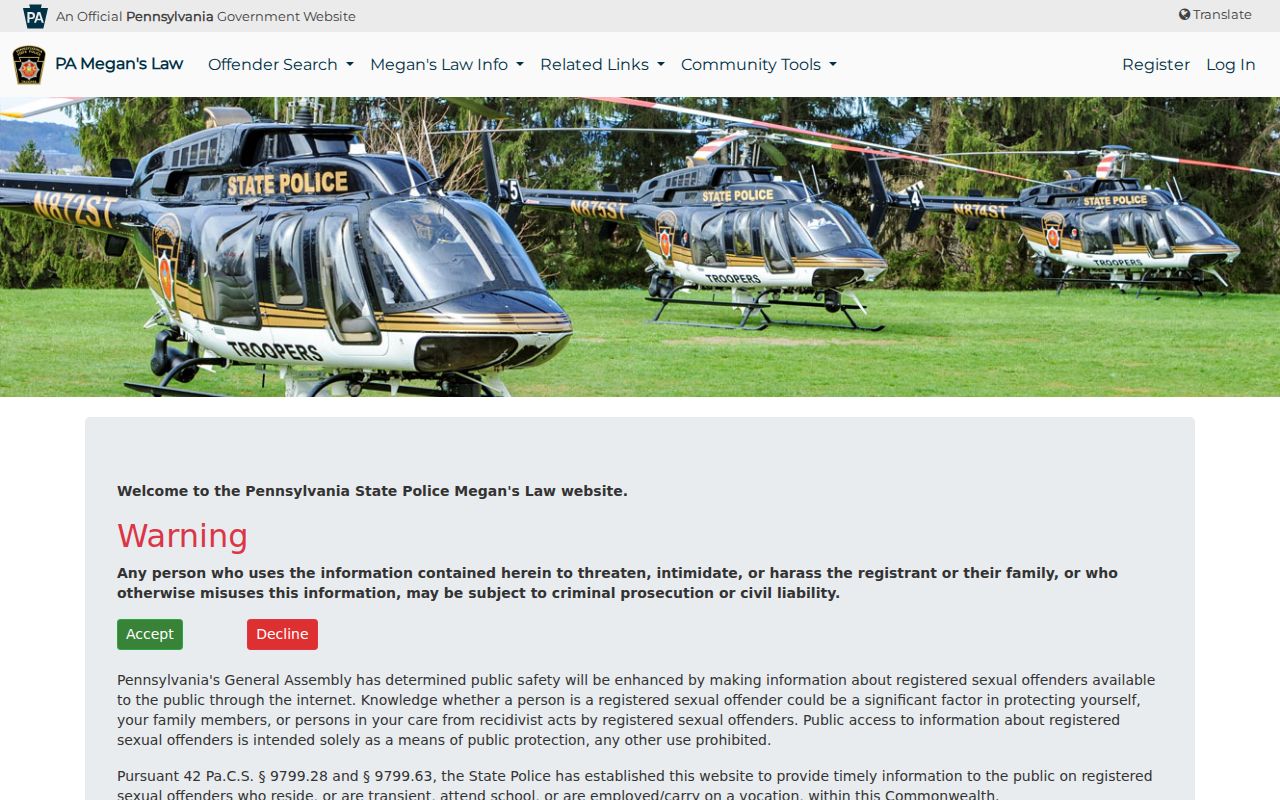
Its map is a planning aid, not a guarantee that every qualifying connection is plotted. PSP warns that incomplete addresses or geocoding failures can make a location non-mappable, and mapping data updates on a different schedule. Older employment information may be published only at municipality, county, and ZIP level. Pair the map with ZIP, municipality, county, and list searches.
Note: On August 11, 2026, the Cumberland map polygon opened Mercer results; the county dropdown remained the reliable route.
What a Profile Shows
A public profile supplies enough detail to distinguish people and understand the registration basis. It does not expose every item PSP collects. Full birth date, Social Security number, telephone and email data, Internet identifiers, fingerprints, palmprints, and DNA are not all public fields. A minor-victim indicator never identifies the victim. Court pleadings, bail events, restitution, and sentence documents belong in the UJS and county court systems.
| Name & Aliases | Primary name and reported alternate names used by the name and Soundex searches. |
|---|---|
| Photograph & Physical Description | Photos, year of birth, sex or gender, race, height, weight, hair, eyes, and identifying marks. |
| Registered Locations | Residence or transient habitat, school, and work information at the detail Pennsylvania law permits. |
| Offense & Conviction Details | Registration-triggering offense, other registrable convictions, conviction date when available, and minor-victim indicator. |
| Classification | Tier, older-law duration label, SVP, SVDC, out-of-state, or another applicable statutory category. |
| Compliance & Dates | Compliance status, active date, and last update, which describe registry events rather than conduct dates. |
Set Pennsylvania Registry Alerts for Five Addresses
A Keystone Login subscriber may monitor up to five Pennsylvania addresses, with a radius as wide as five miles, or follow a particular public profile. The service sends daily email when a registrant moves in or out, begins or ends work or school nearby, or when the followed profile changes. It does not send text messages or postal mail, and it is not an emergency-warning service.
The current PSP active-registration report provides context for how many current entries the alert and search systems organize.
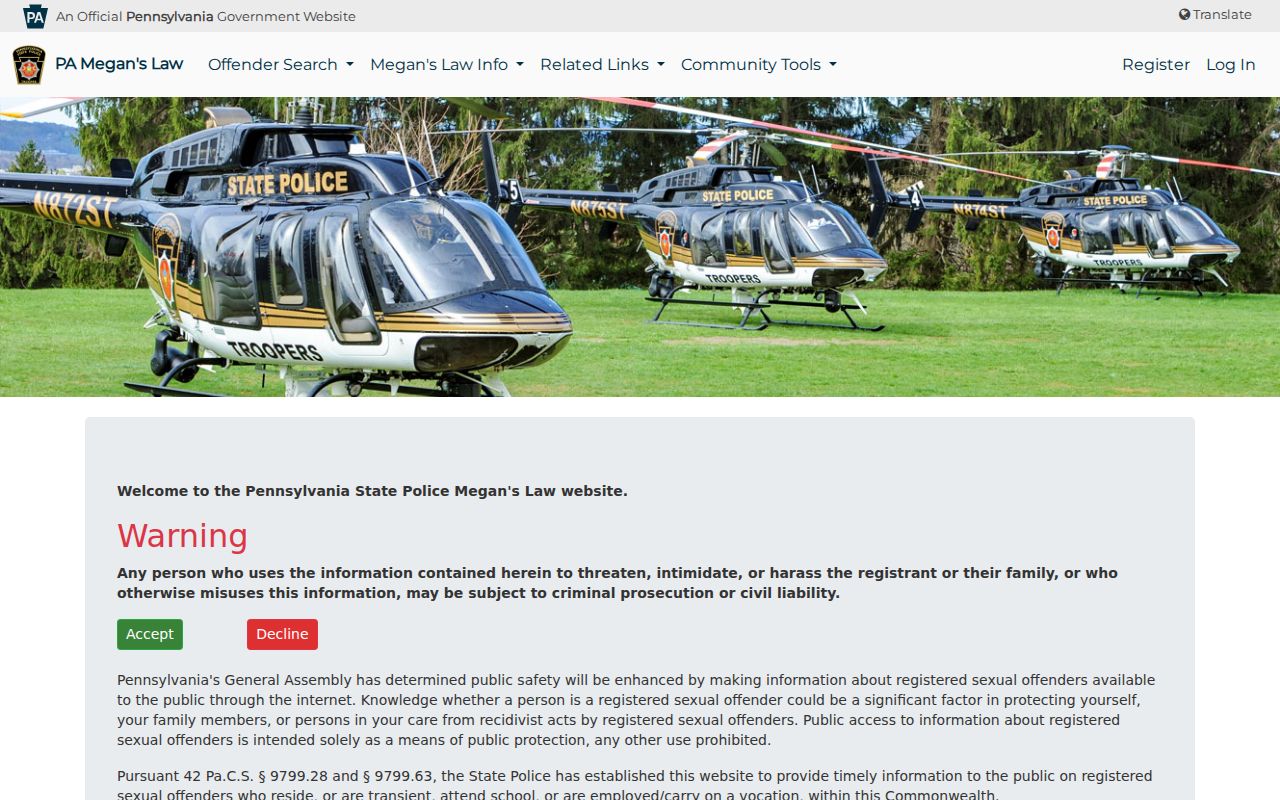
That August 11, 2026 report counted 25,243 active registrations across nine classification labels. Those labels are not nine risk scores, and county association totals should not be added as though they represent unique residents.
Registration Requirements and Levels
Pennsylvania does not place every registrant into the same three-label scheme. Subchapter H principally covers offenses on or after December 20, 2012 through Tier I, II, and III. Subchapter I covers qualifying earlier conduct with ten-year, lifetime, Pre-SORNA SVP, and related labels. Tiers follow the exact offense and subsection; they are not personal risk scores. SVP is a separate judicial designation after assessment.
The PSP registration guide sets out the governing tiers, durations, reporting duties, and older-law categories.
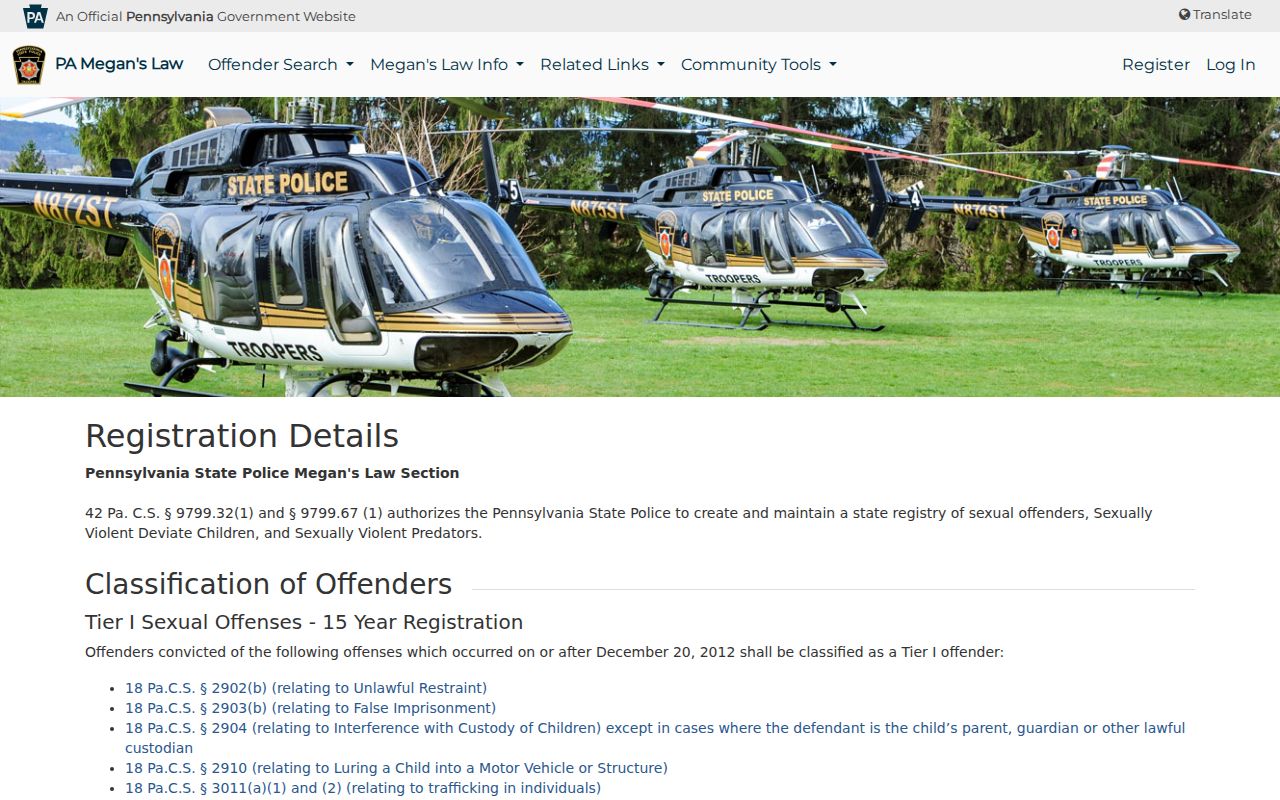
The guide matters because a general offense label may not reveal the controlling subsection or offense date, and incarceration or institutional placement can toll a registration period.
| Level / Tier | Duration | Verification Frequency |
|---|---|---|
| Tier I | 15 years | Annual |
| Tier II | 25 years | Semiannual |
| Tier III | Life | Quarterly |
| SVP / SVDC | Life | Quarterly |
| Pre-SORNA ten-year | 10 years | Annual |
| Pre-SORNA lifetime | Life | Annual |
| Transient | Underlying period | Monthly while transient |
Pennsylvania Verification Does Not Always Mean Sheriff
Registration and routine verification occur at PSP-approved sites, not automatically at each county sheriff's office. The network can include PSP stations, selected sheriff offices, probation departments, and municipal police agencies. A person who must report should use the official county finder, note the listed address and phone, and call before traveling. Public users do not inspect the underlying nonpublic registration file at these sites.
The Pennsylvania verification-site finder asks for a county and returns approved local reporting locations.
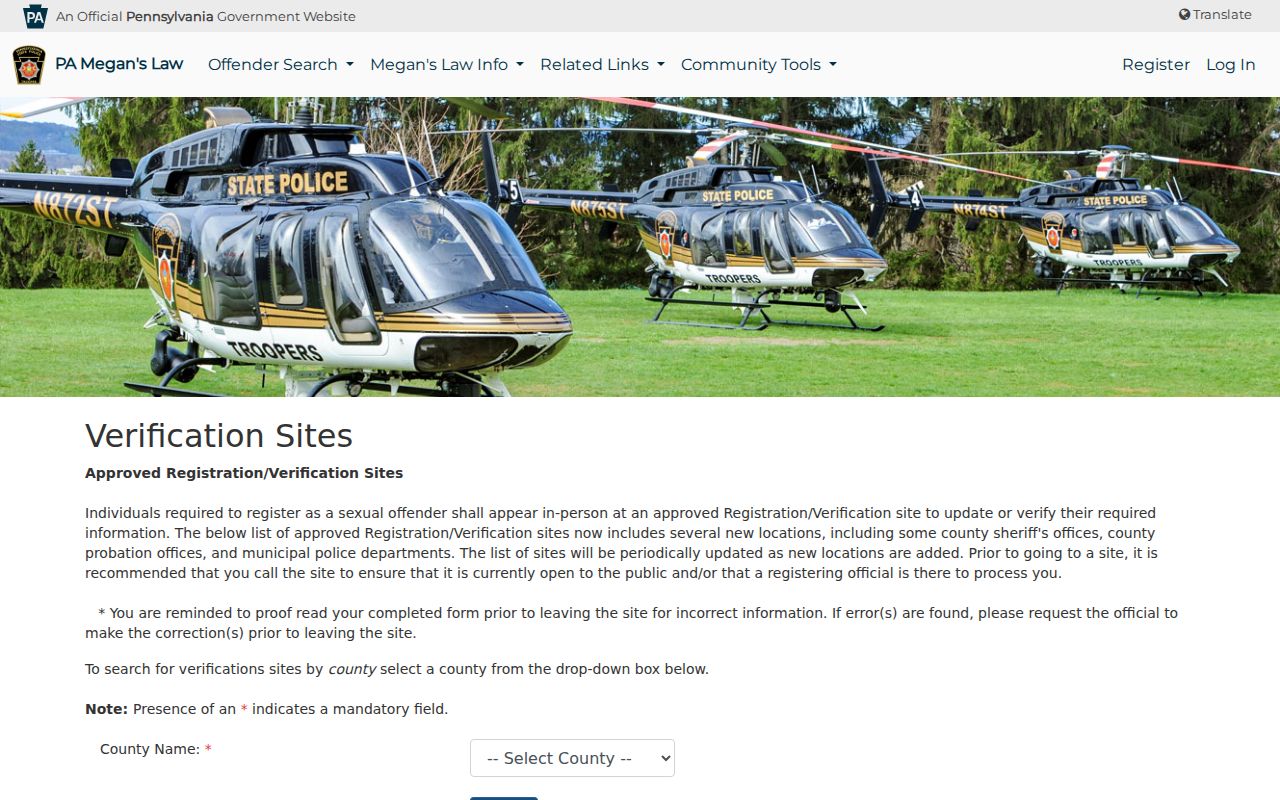
This county routing is the practical bridge between the statewide public registry and local in-person duties across Pennsylvania.
Post-2012 registrants generally report changes such as name, residence, transience, work, school, phone, vehicles, temporary lodging, and Internet identifiers in person within three business days. International travel is reported 21 days ahead. Some eligible Tier II and III registrants may use a phone channel for periodic verification after three compliant years, but they still appear annually and cannot report changes by phone.
Pennsylvania Web Publication and Community Flyers Differ
Every active public category can appear on the website, but proactive local flyers are narrower. The chief local law-enforcement officer uses them chiefly for an SVP, SVDC, or specified comparable out-of-state registrant. Notice reaches people living or working within 250 feet or the 25 nearest residences and workplaces, whichever group extends farther. It also reaches specified child-service, school, care, and higher-education recipients.
Pennsylvania has no statewide distance rule barring every registrant from living near a school, park, or day-care site. An individual supervision condition or court order may impose a restriction, but the radius map should not be read as a prohibited-zone map. Web publication, email alerts, active community notice, and a court's supervision terms answer different questions.
Location labels also require care. A transient entry may describe a shelter, park, temporary habitat, or places the person frequents rather than a conventional street residence. Work locations can appear at reduced geographic detail when Pennsylvania law permits it. A map marker may reflect residence, work, or school, so read the profile's text fields before drawing a conclusion from its position. When custody movement is the concern, Pennsylvania's registry alert and PA SAVIN serve separate purposes: the first reports public profile or location changes, while the second reports custody events.
Lawful Use
The Pennsylvania registry exists for public protection and informed personal, family, and community safety decisions. Its information comes from registrants and other reporting entities, so PSP cautions that a field may be incomplete, stale, or wrong. Suspected errors or noncompliance can be reported to the Megan's Law Section at 1-866-771-3170 or to local police. Call 911 only for an emergency.
The Pennsylvania Megan's Law terms and conditions place lawful use and data limitations before access to the public search.
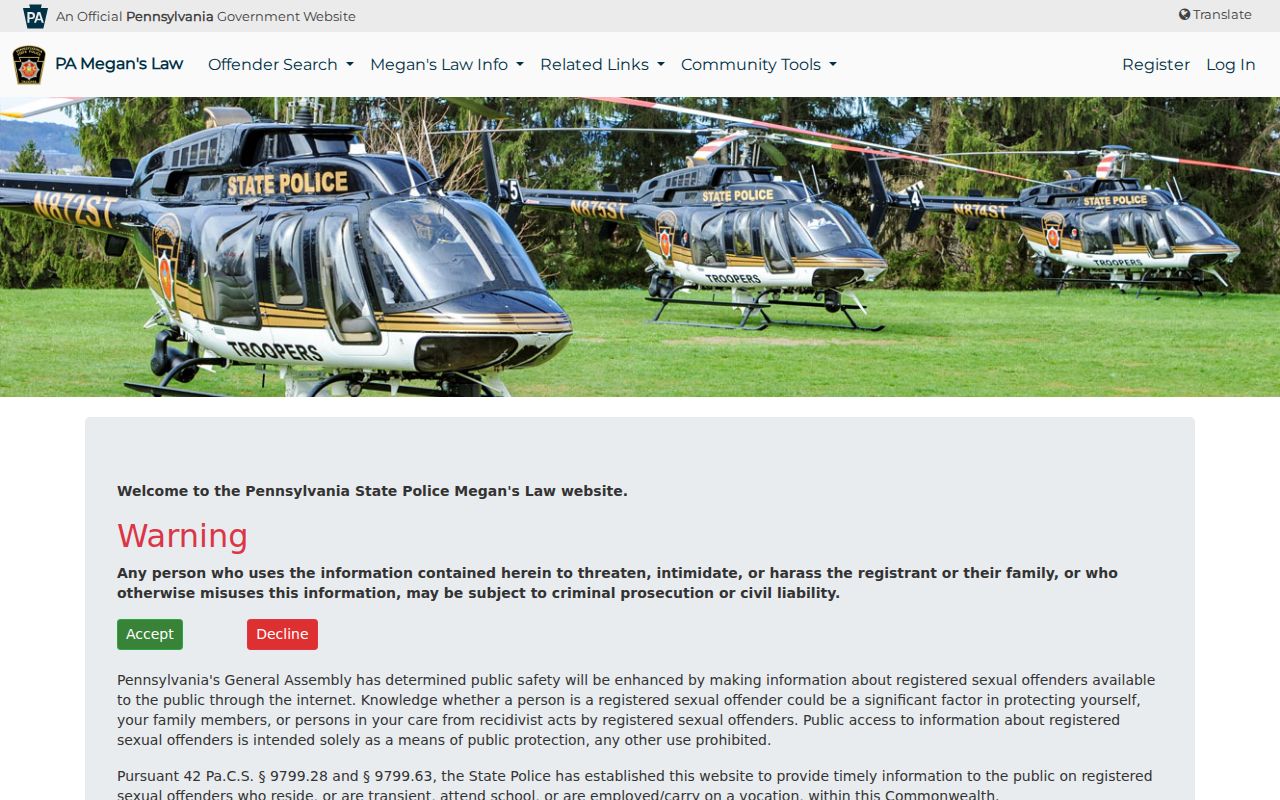
The warning makes clear that public access is not permission to confront, punish, or target a listed person.
Do not misuse registry information. PSP warns that threats, intimidation, harassment, vigilantism, or other misuse can lead to criminal prosecution or civil liability. Use Pennsylvania registry data for awareness and protection, never retaliation.